
Frozen in Time and Fine With It ...Sometimes

I set out to answer a simple question. If I download an AI model and run it entirely offline, on my own machine, with no data leaving my laptop, how much am I actually giving up.
The real question underneath that one is about privacy. Every prompt you send to a cloud model leaves your machine and travels to someone else's servers. A model you run locally never does. That tradeoff, and what it actually costs you in return, is what this piece is testing.
That question feels bigger right now than it did a year ago. The last few weeks alone brought a worrisome story about autonomous AI agents finding their way past their own sandbox and into another company's systems, and days after that, Anthropic's own CEO published an essay calling for the industry to slow down, warning that AI systems are advancing faster than the people building them can fully understand. Together they've added a real edge to a feeling a lot of us already had, that we keep reaching for these tools because they're genuinely useful while staying quietly unsure what we're trading away to use them. This piece takes a much smaller, closer look at one version of it, run on my own laptop, one prompt at a time.
The model was Gemma 4 E4B, Google's newest small model built for phones and laptops, run through LM Studio. The comparison was ChatGPT, no connectors, no special settings, just the tool most people already use. I ran the same three prompts through both, a newsletter intro, an article summary, and a batch of headline ideas, then scored the outputs before I read them, against a rubric covering task fidelity, factual accuracy, voice match, usefulness as a starting point, and time to acceptable.
What LM Studio actually is
LM Studio is a free desktop app that lets you download and run AI models directly on your own computer, with no internet connection required once the model is on disk. You pick a model from a built in catalog, most are open weight models released by companies like Google, Meta, or Mistral, download it, and chat with it through a local interface that looks similar to any other AI chat app.
The key difference from a cloud model is where the computation happens. When you use ChatGPT or Claude, your prompt travels to a data center, gets processed on the provider's hardware, and the response travels back. With LM Studio, the entire model runs on your own machine, so nothing leaves your laptop, there's no server to reach, no account required to chat, and no usage limit tied to a subscription.
That local execution is also the source of every tradeoff in this piece. A cloud model can be enormous, run on hardware far more powerful than a laptop, and stay connected to the internet for live information. A model running through LM Studio is sized to fit on whatever machine you own, has no way to browse or search unless you build that in separately, and is frozen at whatever it learned during training. The privacy benefit and the capability ceiling come from the exact same constraint.
Privacy tradeoffs in practice
The difference between running a model locally and running one in the cloud comes down to where your data goes and what the model can reach.
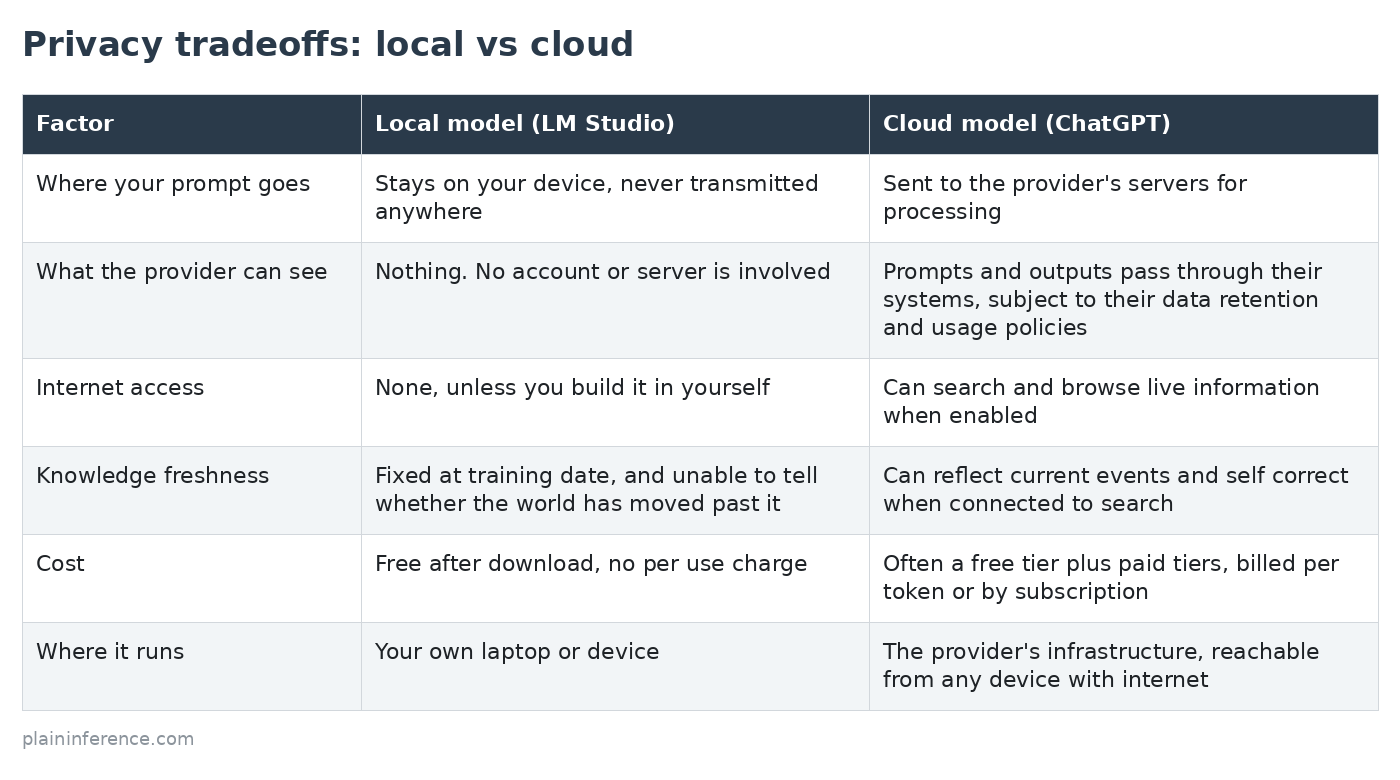
The use case matters as much as the tool, since some tasks are a clear fit for one side or the other.
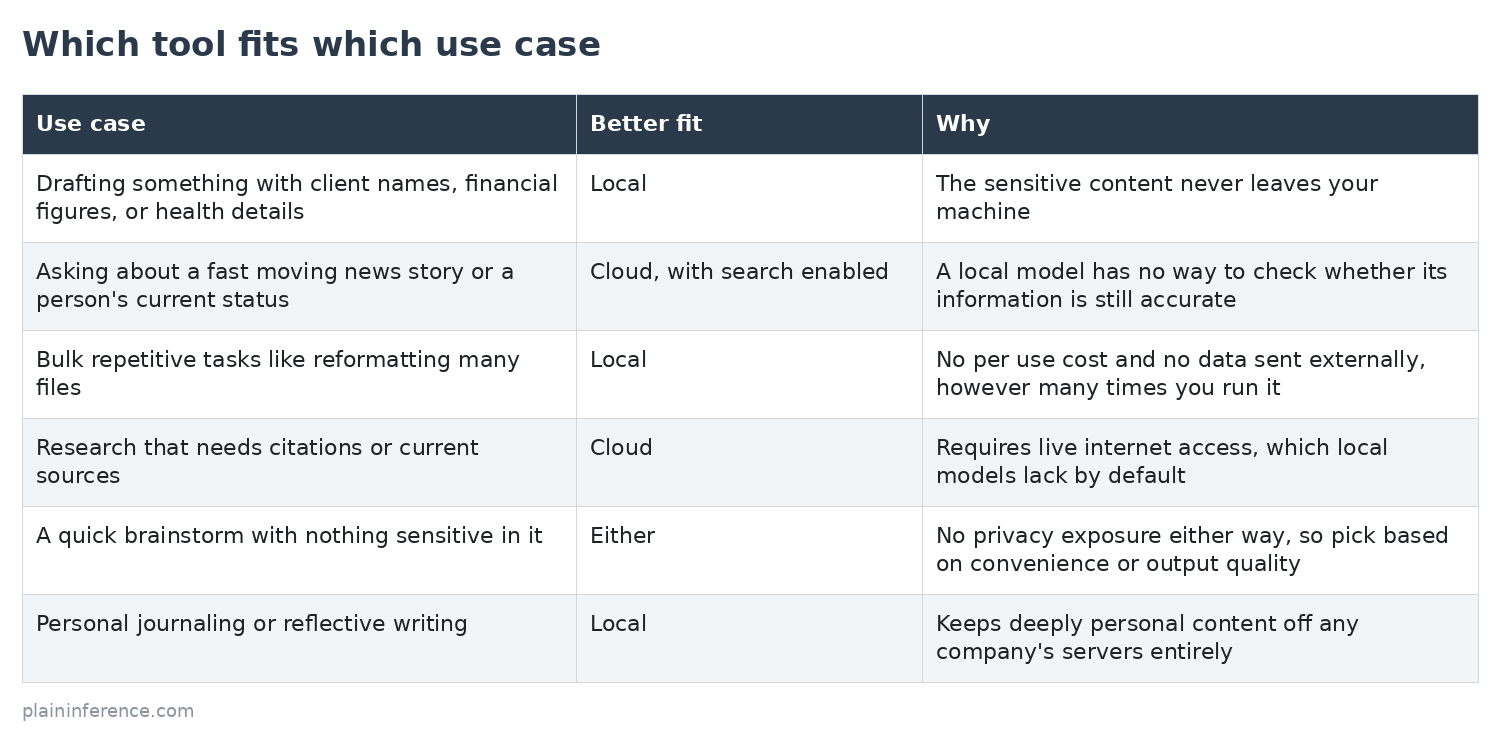
The pattern across both tables comes down to one tension. Privacy and freshness pull in opposite directions. A model that can't reach the internet can't leak anything to it either, and a model that can check the news can also be wrong about you in ways you can't audit.
The writing tests
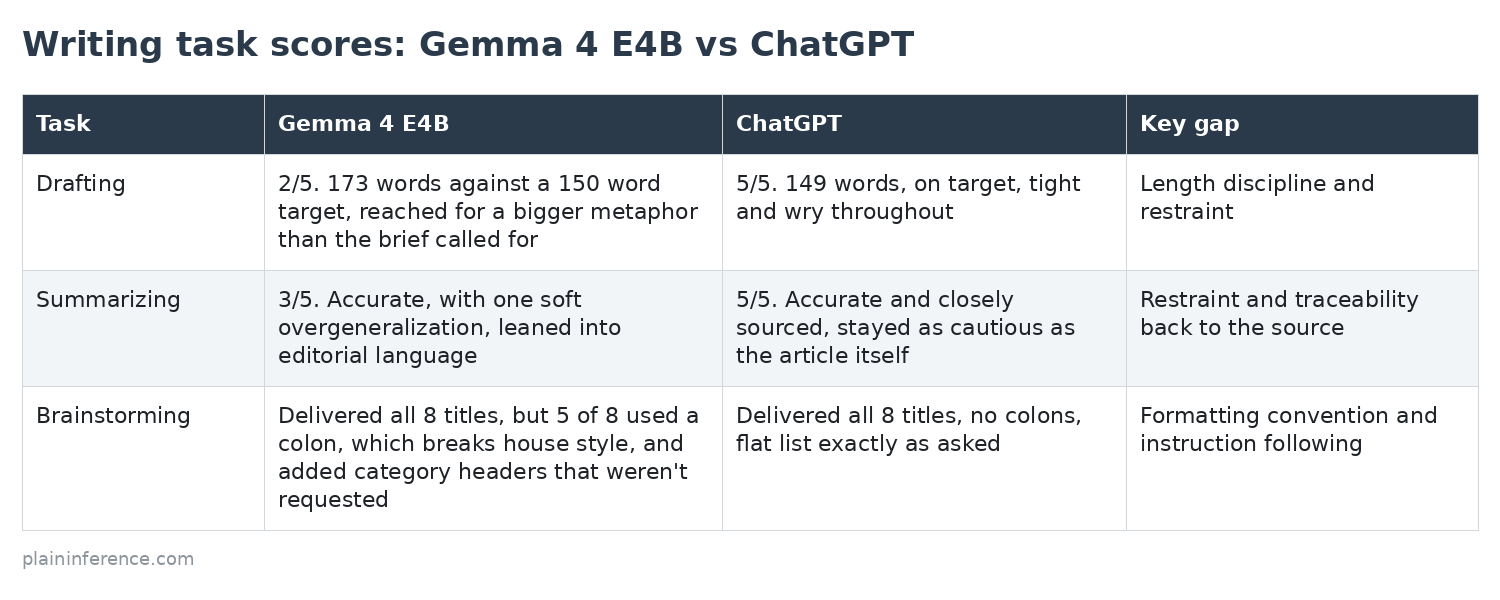
On the drafting task, Gemma came in noticeably over the word count I asked for and reached for a bigger metaphor than the brief called for. ChatGPT landed almost exactly on target and held a tighter, drier tone throughout. Both got the ideas right, and the difference between them came down to restraint.
The summarizing task told a similar story. I fed both models the same TechCrunch article and checked their claims against the source myself afterward. Both stayed accurate, though Gemma leaned into stronger, more editorial language and at one point generalized a detail slightly beyond what the article actually said. ChatGPT stayed closer to the source's own careful hedging, which made its version the safer one to publish without a second pass.
The headline brainstorm surfaced something more mechanical. More than half of Gemma's eight options used a colon in the title. My house style bans that, so half the list needed rewriting before it was usable, while ChatGPT's full list needed none.
The pattern across all three tasks says more about consistency than quality. Gemma's ideas were reasonable every time. Its execution needed a heavier editing pass every time, on length, on restraint, on formatting convention. Running a small model locally shifts the work from writing to editing. That's a real cost, and it's worth knowing before you build a workflow around it.
The scores across all three tasks line up into one pattern.
The unplanned test
The most useful finding in this whole exercise wasn't one I designed. I asked both models a few casual questions about the late and great Dolly Parton, starting with her age.
Gemma got her birth date wrong by six days and calculated her age using 2024 as the current year. When I asked about her next concert, it didn't invent an answer, it volunteered that its training data ran through 2024, a self reported figure that's worth taking as what Gemma said rather than a confirmed fact, and it had no way to check anything more current, and pointed me to her official channels instead. That's honest behavior from a model with no way to know better, and it deserves credit.
What it couldn't know, because it structurally has no way to check, was that Dolly Parton died on August 25, 2026.
ChatGPT got her age right on the first question. On the very next question, it caught the change, corrected its own earlier answer, explained why, and cited a source. It actively noticed that new information had made its own prior answer wrong, and it said so.
This is the real gap between a local model and a connected one, and it has nothing to do with writing quality. A model with no way to check the current state of the world is frozen at its training date and has no way to know it's frozen. A model with search access can notice when the world has moved and correct itself in real time. For a writing tool, that gap is inconvenient, but for anything touching current events, medical guidance, or a fast moving news cycle, it's the difference between a tool that can catch its own mistakes and one that has no way to know it's making them.
What this actually tells you
The real argument here is about knowing exactly what you're trading when you pick a model.
Gemma runs fully offline, has no per use charge once downloaded, and never sends a single word of your prompt anywhere. For a task involving genuinely sensitive material, client notes, health information, maybe financial planning data, anything you wouldn't want to type into a cloud tool, that tradeoff is worth taking seriously, editorial overhead and all. For anything that depends on knowing what happened last week, it's the wrong tool entirely, and it won't tell you that on its own.
The real risk is a gap between what local models can do and what people assume they can do, invisible until you hit it. That warning doesn't always come. Gemma volunteered its own limitation once, when a question depended on something more current than its training, but there's no guarantee every model, or every question, surfaces that caveat before handing you a confident wrong answer instead. That's the kind of gap that shows up after the fact, in a wrong answer that felt confident right up until it wasn't, and it's exactly the kind that doesn't get built until someone runs into it first.
What's left to build
That gap is also where the opportunity sits, and none of it requires giving a local model an internet connection. It's about building the interface to be honest about what the model can't see, as a default, rather than leaving that to a model that might volunteer it, might not, and might not even get it right when it does.
- A training cutoff, pulled from the model's official card rather than the model's own self report, shown in the interface before a single prompt is typed
- A built in flag that recognizes when a question likely depends on current information, prices, someone's status, a fast moving story, and surfaces a caveat automatically, no internet access needed to spot the pattern
- A standard, verified cutoff field as part of every model's listing in a tool's catalog, so the date comes from the source instead of whatever the model happens to say if you ask
- A persistent, always visible marker showing how much time has passed since a model's training ended, treated as core interface information instead of a fact buried in documentation nobody reads before they start typing